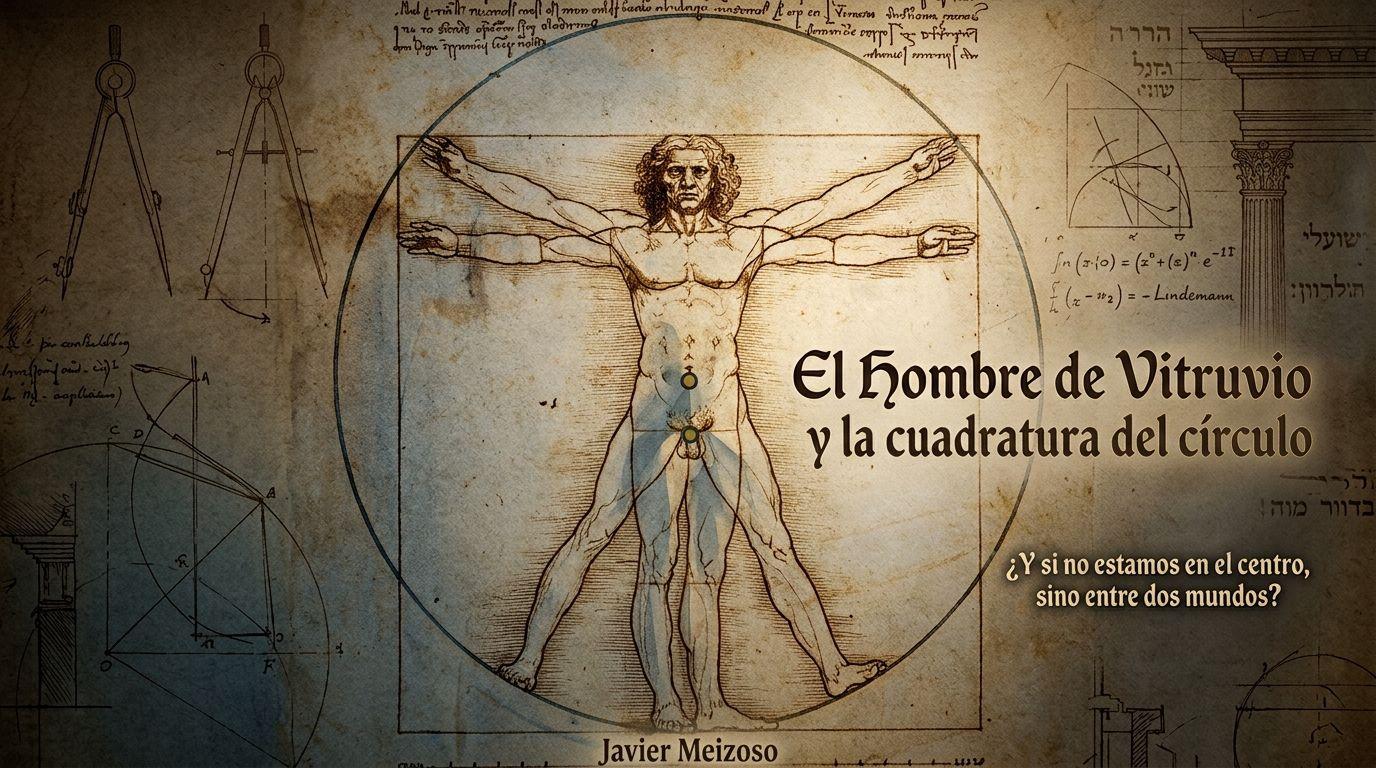
There are drawings we think we know because we have seen them so many times. The Vitruvian Man is on coins, on gym posters, in clinic logos and on the covers of self-help books, always with the same implicit caption: that the human being is the measure of all things. The perfect figure, fitted at once into the circle and the square, man installed at the centre of creation.
Well, the man in that drawing has four arms and four legs, and the circle and the square around him do not even share a centre, but neither of those things is an oversight.
The idea is not his. It comes from a Roman architect of the first century BC. In the third book of his treatise, Vitruvius set down two observations about the human body. The first is that if a man lies on his back and stretches out his arms and legs, and you place the compass on his navel, the circle you trace touches the tips of his fingers and toes. The second is that a person's height, from the soles of the feet to the crown of the head, equals the span of his outstretched arms, so that the body also fits exactly into a square.
Two loose observations, but Vitruvius never said they should be drawn together, nor did he leave anything written about how they relate, or whether they share anything, or what happens if you lay them over the same body. He noted them separately and went on with his treatise on architecture.
For fifteen hundred years nobody saw the problem hidden in that, and the problem is that the two figures describing the same body cannot have the same centre. The centre of the circle is the one Vitruvius gave, the navel. The centre of the square has to sit at half the height, because that is what squares are like, and half your height does not fall at your navel. It falls considerably lower, at the pubis.
And this is nobody's peculiarity and no error of measurement. Human proportions simply do not allow anything else. There is no way for the centre of the circle and the centre of the square to be the same point in a real body.
Those who tried before Leonardo did what anyone would have done, which was to force it. Francesco di Giorgio in the 1470s, and Cesare Cesariano decades later, drew the circle and the square around the same centre at the navel, as logic demanded. To make it work they had to stretch the limbs and shrink the head. They produced monsters. The geometry imprisoned the body instead of describing it.
Leonardo did not solve the problem. He did something better, which was to accept it. He left the circle centred on the navel and the square centred on the pubis, each one where it belongs, the two centres displaced from one another, and without deforming anything to make them fit.
And then one last difficulty remained, because if the centres do not coincide the body cannot touch both figures in the same posture. So he drew two. One pair of arms is horizontal and the legs are together, and that is the posture that fills the square. The other pair is raised and the legs are apart, and that is the one that reaches the circle. It is not a drawing with a mistake in it. It is a single figure in two positions at the same time, about as close to a motion photograph as anyone could get in 1490.
The Vitruvian Man is not standing still at the centre of anything. He touches both forms only because he moves and oscillates between them.
And the man drawing this was not a painter illustrating an old treatise on commission. Leonardo spent years wrestling with a problem that had been open for two thousand years, the squaring of the circle, which consists of constructing with ruler and compass a square with exactly the same area as a given circle. He came back to it again and again in his notebooks, in his own empirical way: trying constructions and measuring what came out. There is a note of his in which he writes, elated, that on the night of Saint Andrew he had finally found the solution. Shortly afterwards he discovered he had not. The note breaks off abruptly, as if he had not been able to bring himself to write down where he had gone wrong.
That the problem is impossible to solve was not proved until 1882, when Lindemann showed that π is a transcendental number. Until then, trying was perfectly reasonable.
What is more, during those same years he was living with Luca Pacioli, a mathematician friar, taking mathematics lessons from him and illustrating his book De divina proportione, completed in Milan in 1498. That book argues in so many words that there is a proportion deserving to be called divine, and gives its reasons one by one. That it cannot be expressed exactly represents that God is incomprehensible, and that it repeats identically at every scale represents that He is everywhere.
So the man drawing a circle and a square over a human body is someone who has spent years confirming at his own desk that those two figures will not be reconciled, and who lives with a mathematician for whom what cannot be expressed exactly is precisely the image of the divine.
And in the drawing the circle and the square do not even have the same area. The circle is considerably larger, by around fifteen per cent. So the Vitruvian Man is not his solution to the squaring of the circle, it is the representation of the dilemma held in tension and as a process. What he could not resolve with ruler and compass he left resolved in a body that moves.
And the two figures that body touches are not just any two shapes. A circle has no sides, no corners and no orientation. All its points are alike and there is no up in it, no right, no front. It is the figure of what has neither limit nor direction. A square is the opposite. It has four sides and four directions and therefore an up and a down, and it is the figure of what has an edge and therefore has form. The human being, according to the most famous drawing of humanism, is at the centre of neither of them.
In the research I have been doing on what I call the ontology of the bond, this is exactly what I argue. The finite and the infinite do not meet because one absorbs the other, nor because the two end up being a single thing. Their relation needs a distance, a space where they can touch without ceasing to be distinct. If that distance disappeared altogether, what would disappear with it is the bond, and therefore consciousness itself.
And the human being lives in that space. He has a body, a measure, a history and a time, so he is finite. But he can also ask about what does not end, sense what does not fit in his senses, and look for a meaning that overflows his own life. That is why I like to think of the body as a living temple. Not a temple that abandons matter in order to reach the sacred, nor a matter reduced to mechanism and necessity, but the concrete place where the spiritual can become experience, gesture, care, speech and presence.
The tradition I have been studying for years, the Kabbalah, has a name for the one who holds both sides without resolving them. He is not the one who has arrived anywhere, nor the one who has overcome the tension, nor the one who has found a point of calm where everything fits. He is the one in the middle, the one who has not won, and what defines him is not having found balance but enduring an imbalance that oscillates. In Hebrew he is called beinoní, which means exactly that, the intermediate one. And what is said of him is the same thing the drawing says: that he does not occupy a point, that his place is not a location but a movement, and that he stops being there the moment he stands still.
That is why attempts to resolve it produce monsters, just as in the drawing. Whoever decides that only matter counts stretches one part and shrinks the other. Whoever decides that only the elevated counts does the same in reverse, and looks at the body, at money, at work and at the obligations of every day as distractions to be shed. The two operations are the same one, and they consist of eliminating one of the two centres in order to rest at last in the one that remains. It is cheaper, and it comes out deformed.
And here I am speculating, for the record. Leonardo left nothing written about what he meant by that drawing, and whatever we read into it we are the ones putting there. But it is hard not to think it. A man who spent years trying to reconcile the circle and the square and could not. Who lived with someone writing that the inexpressible is the image of the divine. Who knew how to measure, and therefore knew the two figures do not come out equal. And who ended up drawing a body that belongs to both without resting in either, in two postures at once, with the centres displaced and nothing deformed to make it fit. I do not think he left us a canon of proportions. I think he left us, set down in an image, how a human being is to live the experience of being alive, oscillating between the divine and the material, without either one becoming a whole in which to rest.
For five centuries we have looked at that drawing as if it proclaimed that we occupy the centre of everything. To me it says something different, which is that the centre is not a point where we can come to rest but a relation that has to be held.
Trying to go deeper into the symbol, perhaps duality and dilemma only become a problem when we try to take the part for the whole, when we turn ideas into dogma or into idols so that we can rest in them, because holding the bond between the finite and the infinite for ever weighs on you, there is always an Other confronting you and demanding that you move, but perhaps that is where divinity lies, not in a static point to be worshipped, but in the very process that forces you to keep moving towards greater coherence.