
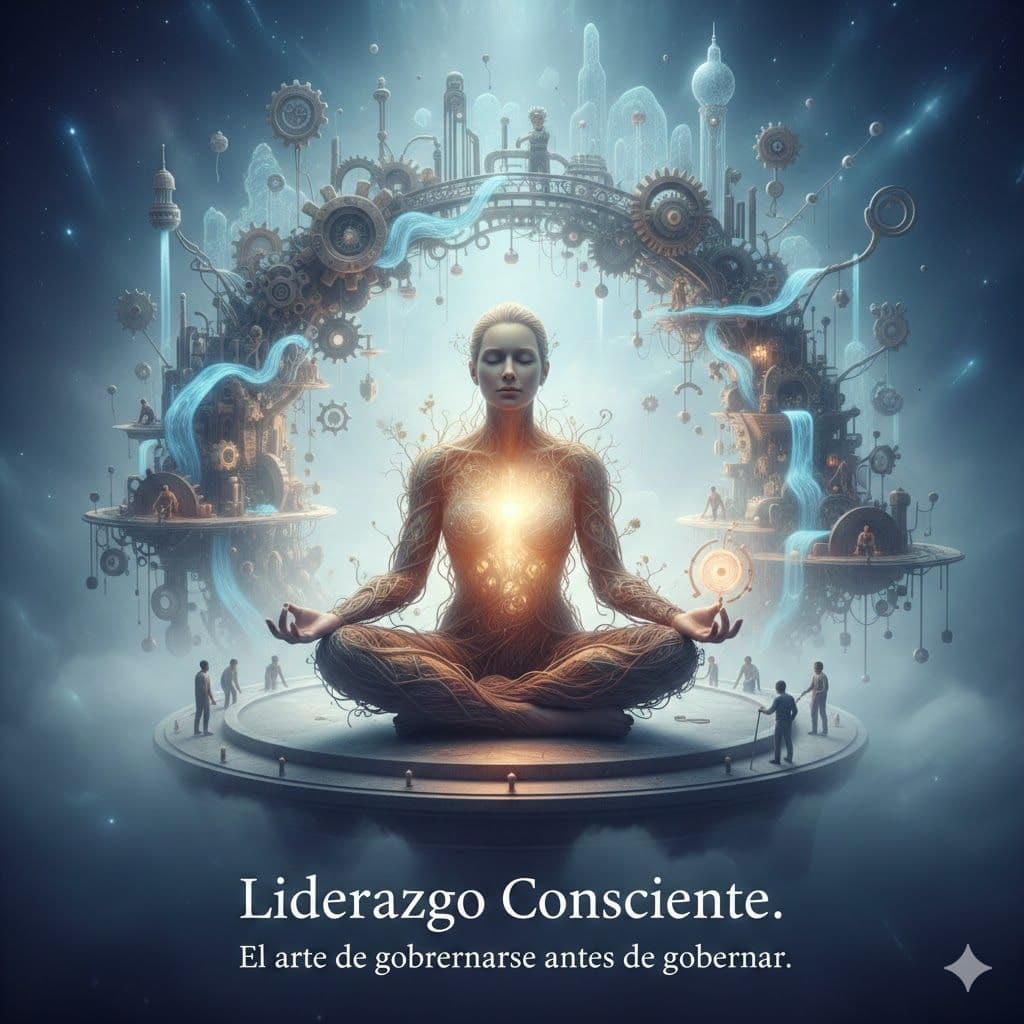
Conscious Leadership: Govern Yourself Before Governing Others
For a long time, I associated leadership with the ability to influence, to make decisions, to set a direction—as if leading were primarily about occupying a position from which to guide others. Over the years, I have realized that all of this is just the surface, because real leadership begins much earlier—it begins within oneself, in the way one governs oneself when no one is watching.
In my own journey, I went through stages where I understood power as something external, as a visible conquest related to money, business, or influence. Like many people from humble backgrounds, I felt a natural drive to grow, to expand, to prove that I could go further. That drive is not negative—it is life energy—but over time I understood something that business schools rarely teach: leadership sought anxiously almost always stems from a lack, while leadership that arises from healthy self-esteem does not need to impose itself or justify itself.
Conscious leadership is not about controlling others; it is about governing oneself. When a person has solid inner self-esteem, they do not need to exert constant pressure to maintain their position, they do not need to demonstrate authority at every step, nor surround themselves with symbols of power to feel validated. Their presence is enough because they are not seeking power to fill a void—and paradoxically, this is precisely when leadership begins to appear naturally, almost as an inevitable consequence of coherence.
I have often observed that those who obsessively seek power are trying to resolve something internal that they have not yet integrated. This happens in politics, in business, and in finance, where we frequently see decisions driven by the need to control, to stand out, or to dominate. Ambition in itself is not the problem—the problem arises when power becomes a prosthesis for self-esteem, and that is when inconsistencies, excesses, and contradictions emerge, ultimately weakening what was supposedly intended to be strengthened.
Conscious leadership is based on a different foundation: self-knowledge. When one knows oneself, one understands that they can be a bridge that helps others grow—but also knows that they can become the team’s limitation if they do not continuously self-reflect. Like any bridge, it connects when understood as a means, and separates when believed to be an end in itself. This is a fine line that requires inner vigilance, because a leader who feels indispensable stops listening—and when they stop listening, they begin to block the talent around them.
That is why leadership demands constant reconstruction. It requires asking oneself honestly whether the frictions that arise within the team have anything to do with oneself; it requires accepting constructive criticism without perceiving it as a personal threat; and it requires surrounding oneself with smarter people without feeling uncomfortable about it. Only those who are aware of their limitations enjoy learning from others, and only those who enjoy learning can evolve alongside their team.
When one understands a company, a project, or any area of responsibility as a school, the approach changes fundamentally. Every decision ceases to be a declaration of authority and becomes a learning experience; every reaction from the team transforms into valuable information; every mistake stops being a threat and becomes an opportunity to adjust. Leadership ceases to be a firm, immutable stance and becomes a living, dynamic process, in which promoting ideas is as important as observing how reality responds to those ideas.
Life always gives something back—markets respond, teams respond, projects respond—and in that response there is a lesson that can only be received by those willing to change. Only those who accept that they do not have all the answers truly learn, and only those who do not cling to their identity as if it were final truly evolve. In today’s world, marked by constant transformation and uncertainty, the greatest risk is not making mistakes, but becoming rigid.
Dying every day, in a symbolic sense, means letting go of old versions of oneself, reviewing beliefs that may have worked in the past but no longer serve in the present, and accepting that change is not weakness but intelligence. Adaptation is not opportunism—it is understanding the context. Only those who know themselves well, who have enough self-esteem to live without defensiveness, and who are willing to reconstruct themselves can lead in times of deep change.
Conscious leadership does not seek dependent followers—it seeks autonomous people; it does not impose discipline out of fear, but inspires commitment through coherence; it does not rely on excessive control, but on trust and example. And that example always begins with radical responsibility, because when something fails, the first question should not be who failed, but what I can learn from this and how I can improve.
Over time, I have understood that the only truly stable power is self-mastery. External power fluctuates, positions change, contexts transform—but the ability to know oneself, correct oneself, and rebuild oneself remains. From that place, leadership ceases to be a goal pursued anxiously and becomes a natural consequence of how one lives and how one confronts their own limits.
At its core, leading is not about directing others—it is about inspiring others to lead themselves, and this is only possible when the first person willing to change every day is the one occupying the leadership position.