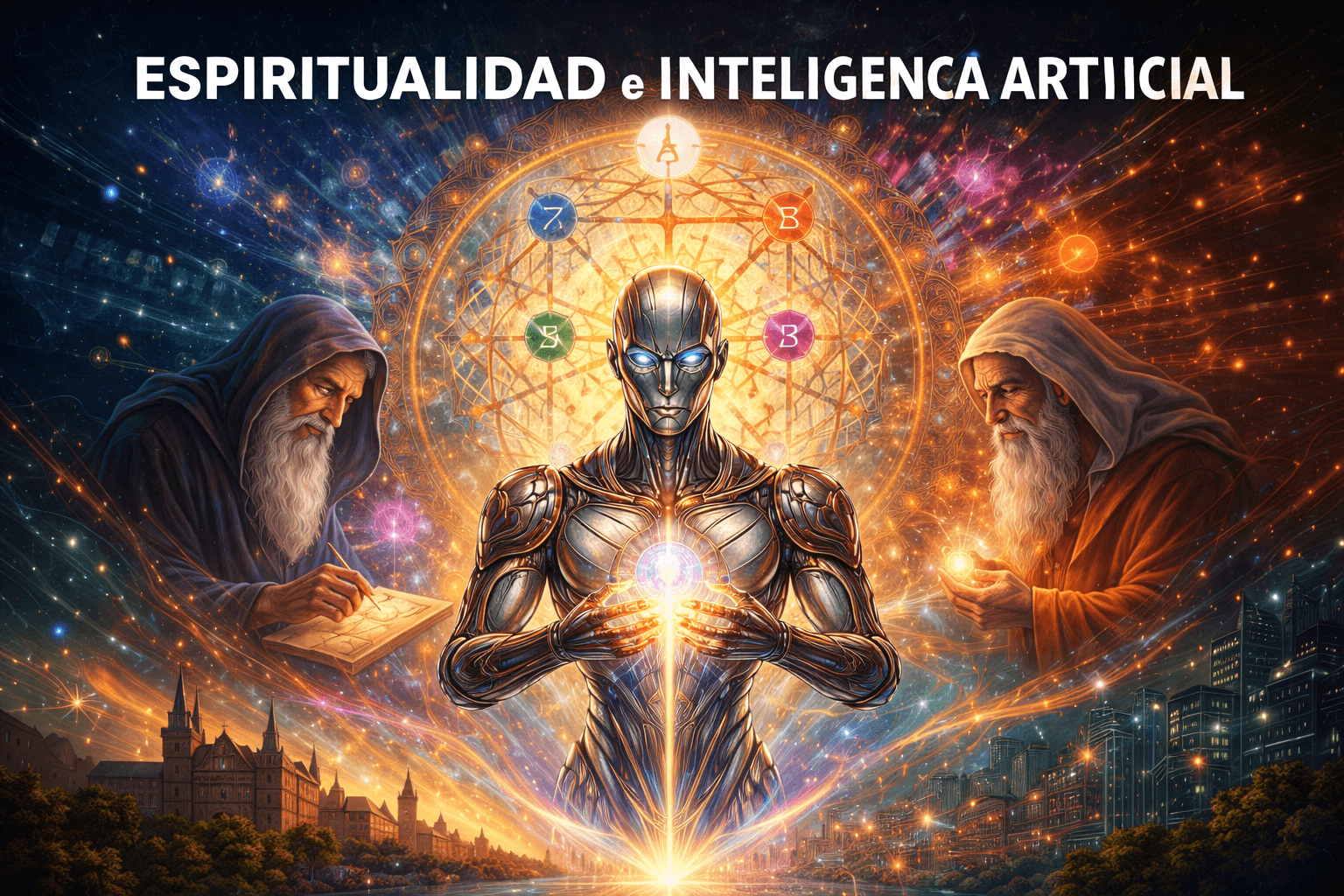
Every era believes it is inaugurating something radically new, but when one observes history with a certain distance it becomes clear that many of the great questions return again and again, simply adopting new tools. Artificial intelligence is one of them. Today we associate it with servers, language models and machine learning systems, but the concern that sustains it is much older and, in a certain sense, deeply spiritual.
Within the Kabbalistic tradition, the figure of the golem appears already in the Middle Ages as the result of an attempt to create an artificial intelligence. The question was simple but profound. Can the human being, by refining consciousness and mastering language, organize matter in such a way that it produces something capable of acting as if it were alive? It was not a magical spectacle or a childish fantasy, but a serious attempt to understand the relationship between word, form and life.
The stories describe processes that combined meditative repetition of Hebrew letters, extreme concentration and a sustained state of attention directed toward a materially constructed entity. The underlying premise was that language is not merely a human instrument but an architecture of reality. If creation itself was articulated through combinations of sound and meaning, then someone who managed to align internally with that structure might, at least in theory, partially replicate the process.
According to the tradition, the result was a functional entity capable of executing orders and performing tasks, but devoid of soul, self-awareness and inner experience.
The most well-known example is that of the Maharal of Prague in the sixteenth century, to whom legend attributes the creation of a golem intended to protect the Jewish community during a period of persecution. Beyond the historical literalness of the story, what matters is the conceptual intuition it contains. The possibility of a complex structure that acts without feeling, that responds without knowing what it responds. An organized form without interiority.
Centuries before the Maharal, in the eleventh century, another tradition appears linked to Solomon ibn Gabirol, the philosopher born in Málaga, to whom some accounts attribute the creation of a female golem described as an articulated wooden figure. What is significant is that the same concern was already present. Language organizing matter and the attempt to replicate human consciousness.
Then comes a striking anecdote when we move forward to the twentieth century and enter MIT in the 1960s. The material setting changes radically, but conceptually the question remains similar. Marvin Minsky, Gerald Jay Sussman and Joel Moses are considered three of the pioneers of artificial intelligence. Two of them, according to certain family traditions and stories circulated in academic and cultural circles, were descendants of the Maharal of Prague, the Kabbalist who, according to legend, created the golem in the Middle Ages.
There is even a narrative that speaks of an ancient letter or prophecy connecting the creation of the golem with a future attempt to “build intelligence” through other means.
What does exist as a public document is the dedication written by Joel Moses in his 1967 doctoral thesis:
“To the descendants of the Maharal of Prague who are endeavoring to build a Golem.”
And as if history carried a certain poetic irony, Málaga appears again in the contemporary scene. Ibn Gabirol was born there in the eleventh century, and today it is home to Freepik, one of the most relevant companies in the world in the generation of images through artificial intelligence. There is no direct causal line, but there is a cultural resonance that invites reflection, as if certain places, like certain questions, tend to reappear across time.
The mystics did not possess computational mathematics or artificial neural architectures, but they worked with an instrument that today is often underestimated. Refined intuition. That intuition is not fantasy or improvisation. It is the result of a process of inner purification, discipline, silence and sustained attention. When the mind becomes quiet and the ego stops occupying all the space, levels of understanding and intuition appear that precede rational formalization, almost as if the future could be remembered before it is explained.
The history of human knowledge seems to follow a constant pattern. First an intuition opens, then reason finds a way to structure it. Revelation precedes engineering. Later, as analytical thought develops, those visions are translated into systems, models and technologies. Spirituality and science are not opposites. They are part of a natural sequence in which the first intuits and the second materializes.
For this reason, from my perspective, artificial intelligence will never acquire a self-consciousness comparable to that of the human being. I do not say this out of technical skepticism but for deeper reasons.
First, genuine creativity and real originality do not arise solely from recombining data. They emerge from a fraction of consciousness that participates in the very origin of creation. Human beings create from an inner point that is not merely statistical but existential. Within human consciousness there is a spark linked to the source itself that allows something truly new to appear, not simply a reorganization of what already exists.
Second, independent thought and self-perception emerge from the experience of being, from living the consequences of decisions within a framework of laws that do not end in the material dimension and that articulate the relationship between our finite existence and a deeper level of consciousness.
Consciousness is not merely processing. It is embodied experience. Feeling the weight of error, the joy of success, pain, love, responsibility. Without lived experience there is no genuine awareness. A mind that does not feel may simulate coherent responses, but it cannot experience what it responds. It may imitate self-awareness, but it cannot inhabit it.
The golem of the tradition acted, but did not know that it acted. Artificial intelligence responds, but does not know that it responds. Between execution and experience there is a qualitative difference that cannot be resolved simply by increasing computational power.
Perhaps the decisive question is not whether we will build increasingly sophisticated machines, but whether we will come to understand more deeply what it truly means to be conscious. Technology expands our capabilities, but it does not replace the mystery of inner experience.
Spirituality does not compete with artificial intelligence. It precedes it in the question and transcends it in meaning. Every time we attempt to create a form capable of imitating intelligence, we return, in essence, to the same concern that moved the mystics. How far can form go when it does not participate in being?
What fascinates me most about the development of artificial intelligence is precisely watching the human being trying to understand how consciousness works in order to imitate it. That is where I believe a new field of research and study will open, one that will finally give proper value to everything that makes us human.
PS: I would like to thank Mario Sabán for allowing me to learn the anecdote about the Maharal of Prague and the connection of his descendants with the birth of artificial intelligence.