With the evolution and widespread adoption of artificial intelligence, a question emerges that crosses philosophy, politics and culture. What happens to ethics when decisions begin to be delegated to increasingly complex systems? Can artificial intelligence develop an ethical criterion? My answer is clear, it cannot.
With the rise of artificial intelligence this issue has come to the forefront with particular intensity. Governments, universities and large technology companies constantly speak about the ethics of artificial intelligence, about regulatory frameworks, ethical oversight of algorithms and the need to build systems capable of making responsible decisions.
However, in the middle of this debate I perceive a rather common confusion. People speak about ethics when in reality they are often speaking about morality, and although in everyday language we tend to use both terms as if they were equivalent, there is in fact a profound difference between morality and ethics.
Understanding that difference can also help us understand one of the fundamental limits of artificial intelligence and one of the virtues of human consciousness.
The distinction becomes clearer when we look at the origin of the words. The word morality comes from the Latin mos, moris, which means custom, something that a community repeats for so long that it eventually becomes a norm. Morality, in this sense, is the set of values, rules and conditionings that one learns because a society considers them correct within a particular historical moment.
Morality depends on cultural context, on tradition, on dominant religion and also on the balance of power that exists in each era. Yet what is considered unquestionable at one moment in history may later appear deeply unjust, either at another time or in another place.
Ethics, however, has a different root. It comes from the Greek term ethos, which relates to character and to the way of inhabiting the world, not so much to a system of external rules as to an inner orientation that guides our decisions when existing norms begin to fall short in the face of a broader understanding of reality.
Throughout history morality and ethics have often coincided, but not always, and that difference has been precisely the engine behind many profound positive transformations in human societies.
Morality plays an important role because it establishes a shared cultural ground, a framework within which people can organize their coexistence and develop common institutions. Without some form of shared morality it would be difficult to sustain any form of society.
But that same ground also has its limits. Morality always belongs to a specific historical moment, and what is considered correct today may appear deeply inadequate when time introduces new ways of understanding reality.
This is where ethics emerges. The great evolutionary leaps of humanity usually occur when some people begin to feel that the dominant morality no longer reflects a deeper truth. In those moments a tension arises between what society considers correct and what a broader consciousness begins to intuit, an intuition that often forces individuals to challenge established norms in order to open a new path.
History is full of examples of this process. For centuries, for instance, the dominant morality accepted that women should not participate in political life. That rule seemed natural within the culture of its time and was supported by traditions, institutions and power structures that few people dared to question.
Yet there were individuals who began to perceive that such exclusion was unjust. Some were women demanding their place in society, others were men who understood that this rule did not reflect a deeper understanding of human dignity. From the perspective of the morality of that time they were challenging the established order, while from the perspective of ethics they were anticipating an evolution that would later become integrated into morality itself. Fortunately, with time what began as a transgression became a new social norm.
This pattern repeats itself constantly throughout human history. Morality functions as a bridge that allows collective life to be organized during a certain period, yet that same bridge can become a barrier when it is interpreted as a definitive truth instead of being understood as a stage within a broader evolutionary process.
When morality is absolutized, moralism or puritanism emerges, and this often produces a rigidity that ends up slowing cultural and human evolution.
The most vibrant societies are those that allow ethics to dialogue with morality and, when necessary, to transform it.
At this point artificial intelligence introduces a particularly interesting question.
Machines can learn patterns, analyze enormous quantities of information and optimize decisions with extraordinary efficiency. This process of machine learning is precisely what has enabled the recent development of increasingly advanced artificial intelligence systems.
However, all that learning has a fundamental characteristic, it is always based on past information. An artificial intelligence system learns by observing historical data, existing texts, previous decisions, accumulated jurisprudence or human behaviors recorded over time. In other words, it learns from what has already happened.
This means that artificial intelligence can reproduce with considerable precision the dominant morality of a society. It can identify which decisions have been considered correct in the past and apply those criteria consistently in new situations.
What it will never be able to do is guide us toward decisions that contain a truly ethical dimension capable of generating a human evolutionary leap. It cannot connect with a source that transcends those historical conditionings. It cannot experience the inner tension that leads a person to question the accepted rules of their time, nor can it feel the deep intuition that at certain moments pushes human beings to challenge prevailing morality in order to open new paths.
Artificial intelligence can simulate ethical reasoning, analyze philosophical debates or generate complex reflections about ethics in artificial intelligence, yet it will always do so from previously programmed or learned structures.
In that sense an artificial intelligence system may be moralistic, but it will never be ethical.
It can apply an existing system of norms with enormous precision and may even help to do so more coherently and less arbitrarily than human beings themselves. Yet it cannot produce by itself a creative rupture with those norms.
The great ethical transformations of history have not emerged from optimizing the past, but from the human capacity to intuit something that had not yet been codified within any tradition.
Ethics, in that sense, seems to be linked to a dimension of consciousness that does not merely reproduce patterns. A dimension capable of observing existing rules and sensing that the moment has arrived to move beyond them so that something new can emerge.
For this reason artificial intelligence will probably never replace the ethical responsibility of human beings. If anything the opposite will happen. The more decisions we delegate to intelligent systems, the more important it will be to remember that those systems operate within the moral frameworks we ourselves have provided.
The evolution of those frameworks will continue to depend on something no machine can program by itself, our capacity to listen to an intuition that has not yet become a norm.
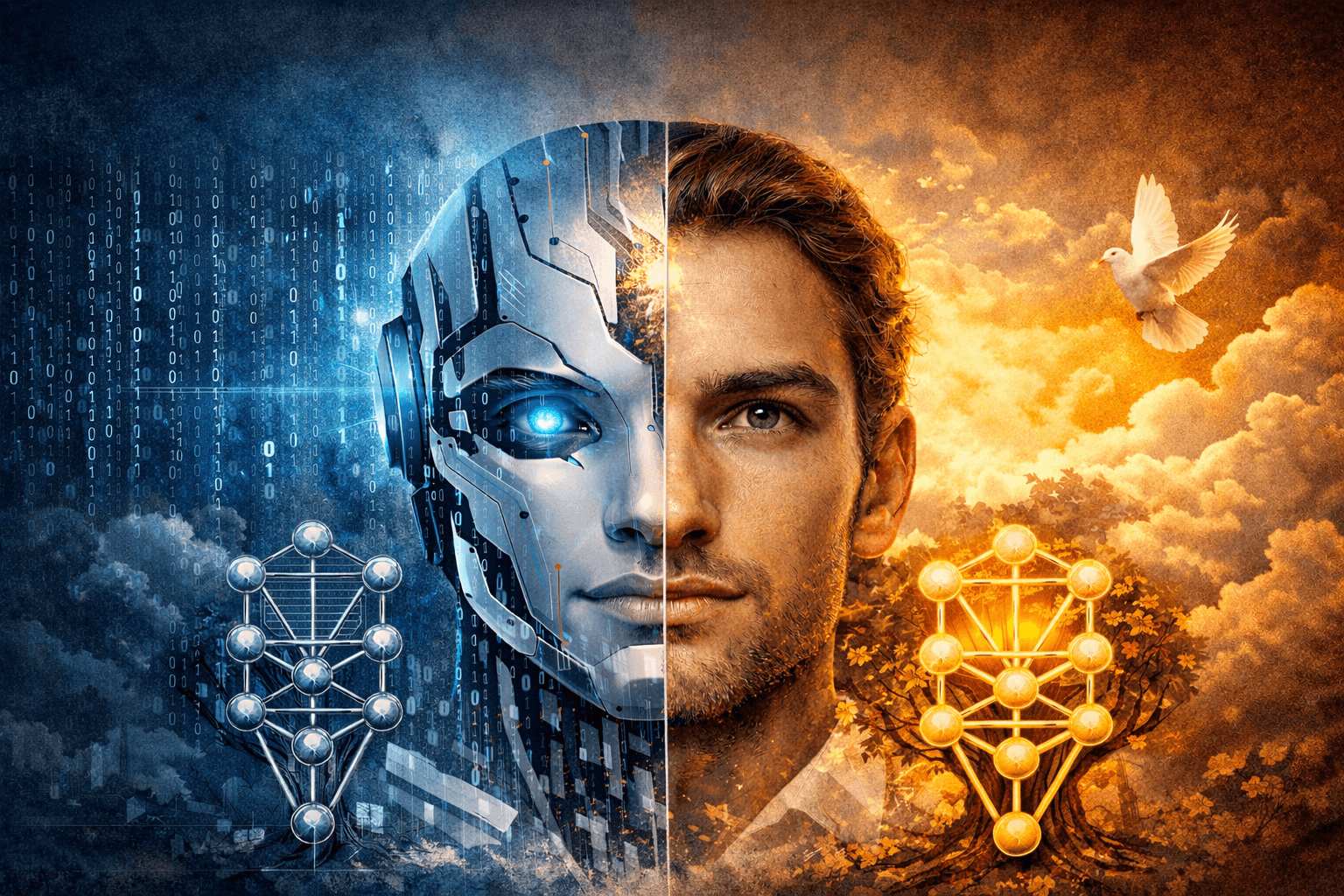
Perhaps one of the most interesting contributions of artificial intelligence will not be technological but philosophical, because when we confront systems capable of replicating much of our reasoning we begin to understand more clearly which parts of the human mind can be automated and which seem to belong to another dimension of consciousness.
Morality can be codified. It can be learned. It can be taught to a machine.
Ethics will remain a deeply human territory.
And perhaps that is one of the most important questions of our time, not so much what artificial intelligence will eventually be able to do, but rather how it can help us understand the transcendental and even divine dimension of the human being.