
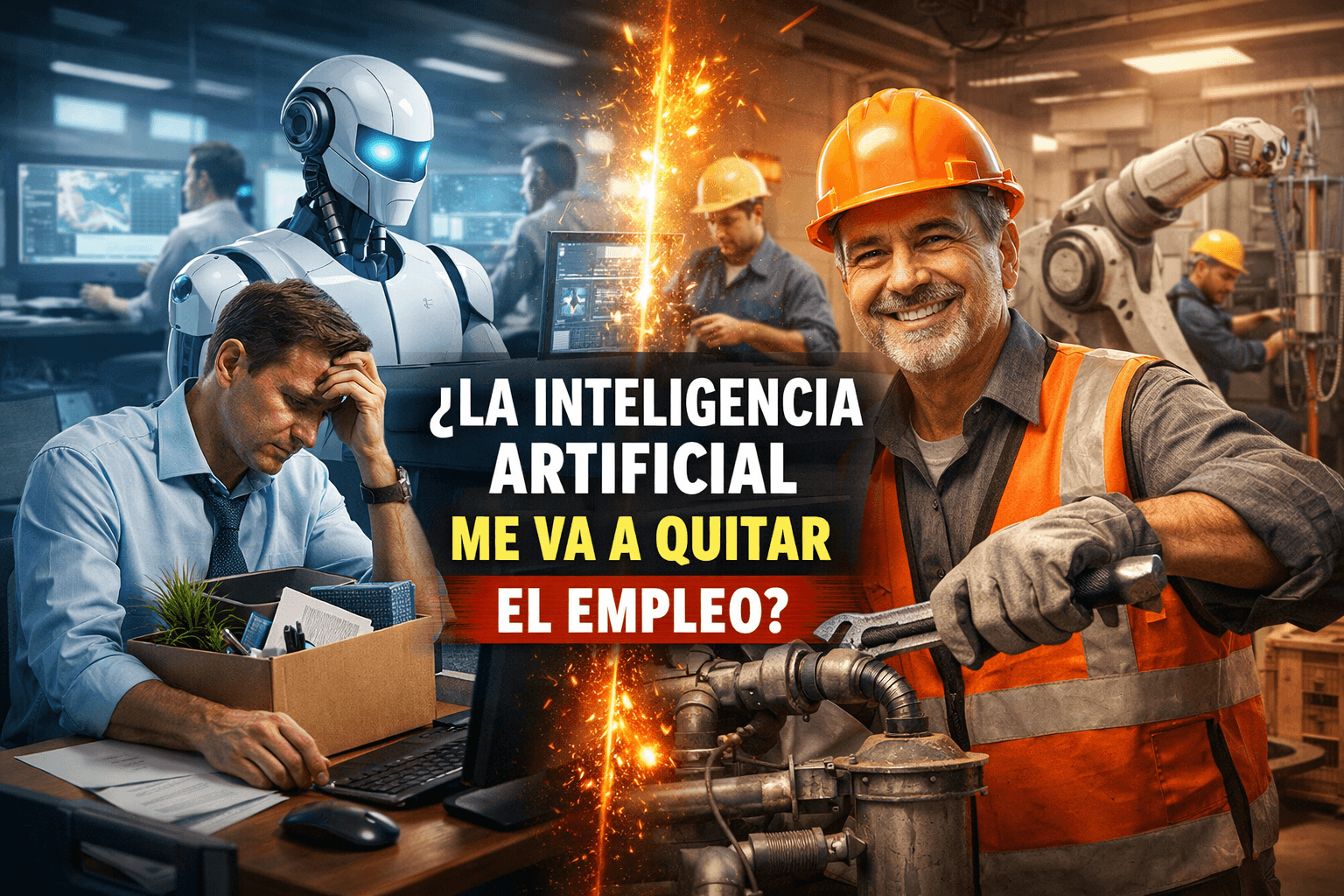
There is a question that is beginning to come up repeatedly, both in private conversations and in public debates, and it carries a certain underlying fear, because it does not only point to work, but to the identity we have built around it.
The question is uncomfortable, will artificial intelligence take my job?
I do not share this reflection as a closed conclusion or as a categorical warning, but rather as an interpretation that is useful to me precisely because it does not allow me to remain still. I am increasingly convinced that an interpretation is valuable not when it gives you certainty, but when it forces you to question yourself, to transform, and to take greater responsibility for what you do and what you are capable of contributing in an environment that is no longer the same.
If one steps back from the noise for a moment and looks at what is beginning to emerge as consensus among leading reports, the pattern becomes quite clear. Studies such as those by McKinsey Global Institute, Goldman Sachs, or the OECD point to something essential, the jobs most exposed are not necessarily the hardest or the least skilled, but those that can be broken down into repetitive, predictable, and structured tasks.
A Goldman Sachs report estimated that up to 25% of work tasks could be automated in advanced economies, while McKinsey suggests that nearly 60% of jobs have at least 30% of activities that could be automated. This does not mean they will disappear overnight, but their relative value is already changing, and it is doing so quickly.
This includes roles such as administrative work, first-level customer support, generic content writing, structured data analysis, and even parts of legal or financial work that are more procedural in nature. Not because they will cease to exist, but because they will cease to be scarce, and when something is no longer scarce, it is no longer valuable in the same way.
However, while this type of work loses weight, a shift begins to take place that is not always openly discussed. Anything that involves physical interaction in unstructured environments, from technical trades to specialized manual work, remains extremely difficult to replace, not so much because of artificial intelligence itself, but because of the complexity of bringing it efficiently into the physical world. For years, an entire generation was pushed toward office jobs under the promise of stability, and now that is precisely where the pressure is emerging most clearly.
In the medium term, it is true that the combination of robotics and artificial intelligence may begin to affect these sectors as well, but the pace will not be the same, nor the level of investment required, nor the capacity for adaptation. Automating a text is trivial compared to automating a physical intervention in a changing environment, with constant uncertainty and real-time decision making.
But there is another layer to this transformation that, in my view, is going largely unnoticed, and that is the impact it may have on public sector employment. It is an uncomfortable area, because it implies questioning structures that for decades have been considered inherently stable, and that in many economies form the backbone of social stability. However, if one looks at the evolution of public debt in many Western economies and the growing pressure on structural spending, it becomes increasingly difficult to sustain the current model without introducing significant changes.
And if that pressure is combined with the rise of artificial intelligence and process automation, which can efficiently take over a significant portion of administrative tasks, the conclusion one may reach, however uncomfortable, is that at some point states will be forced to rethink the size and structure of their workforce.
This is not a common discourse in the public sphere, probably because the political cost of addressing it is extremely high, but it can already be sensed in certain movements, in the growing alignment between governments and major technology companies, in the accelerated digitalization of public services, and in the need to do more with fewer resources. To assume that this transformation will not affect public employment may, in itself, be a way of denying the scale of what is happening.
And yet, even with all this context, I believe the question is still wrongly framed. The issue is not so much whether artificial intelligence will take your job, but whether you will be left out of the transformation process that is already underway.
Because what does seem clear is that those who learn to work with artificial intelligence, to integrate it into their processes, to formulate high-quality instructions, to structure workflows, and to supervise outcomes, will multiply their capacity to generate value. It is not about knowing how to use a specific tool, but about understanding how to think in an environment where many tasks are no longer performed directly by you.
This is where certain skills begin to emerge that are not only retaining their value, but becoming increasingly scarce. The ability to bring order to chaos, to design processes, to sustain discipline over time, to imagine solutions that are not immediately obvious, to make decisions when there is no clear answer, and above all, to maintain an ethical reference when efficiency begins to justify any means.
Because if there is something artificial intelligence cannot do, it is to assume consequences from lived experience or to sustain its own ethical framework. It can generate, optimize, and suggest, but it cannot decide from within what should be done when what is technically possible comes into conflict with what is humanly right.
And there is one final consequence that, personally, I find especially interesting. As more content, processes, and interactions become mediated by artificial intelligence, many experiences will likely begin to resemble one another, becoming more efficient but also more homogeneous. And in that context, I believe what cannot be easily replicated will gain much more value, human imprint, coherence, the sense that behind a company there is a real intention and not just an optimized system.
People perceive this with far more precision than we sometimes assume. They can sense when there is something genuine behind a project and when there is not, even if they cannot explain it in technical terms.
That is why I believe the role of leaders will also change. Not toward superficial exposure, but toward real presence, toward the ability to convey judgment, to take positions, and to sustain a way of doing things that is not solely dependent on efficiency.
In the end, artificial intelligence may not come to take our jobs as much as it comes to force us to stop hiding behind them, to stop defining ourselves by tasks that can be automated, and to start asking what we truly contribute when those tasks are no longer needed.
And in that question, which may feel uncomfortable, there is also an opportunity, the opportunity to rebuild the way we work from a more conscious, more creative, and perhaps more human place.